William Berkeley: Long-serving Governor of Colonial Virginia

Born around 1605 in Hanworth, England, Berkeley served as Virginia's governor. His autocratic governance, defense policies, and opposition to Bacon's aggressive campaigns against Native Americans led directly to rebellion.
Bacon’s Rebellion: Armed Conflict in Colonial Virginia

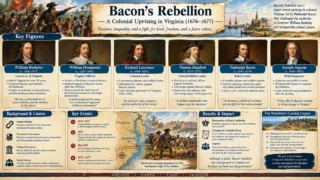
A 1676 uprising in colonial Virginia led by Nathaniel Bacon against Governor William Berkeley. Frustrated by native policies and political disenfranchisement, rebels marched on Jamestown and burned it down.

Bacon’s Rebellion and Virginia’s Power Struggle

Bacon's Rebellion was an armed uprising in the Virginia Colony led by Nathaniel Bacon against Governor William Berkeley. Driven by grievances over frontier security against Native Americans, high taxes, and political favoritism, rebels burned Jamestown and targeted government loyalists. The revolt collapsed following Bacon's death, but it deeply shaken the colonial establishment. In its aftermath, the ruling elite accelerated the transition from indentured servitude to racialized chattel slavery to prevent future cross-racial alliances among lower classes.

Major Wars of Colonial America

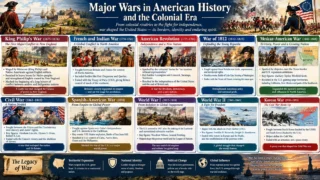
The colonial era in North America was marked by frequent conflicts among European powers, Native American nations, and the British colonies. Major wars—including King Philip’s War, the French and Indian War, and other imperial struggles—reshaped territorial boundaries, trade, and alliances. These conflicts strengthened colonial military experience while increasing tensions with Britain, ultimately contributing to the movement for American independence.

Lawrence Washington’s Military Career and Mount Vernon

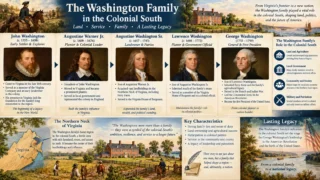
Lawrence Washington served as a captain in the British Army during the War of Jenkins' Ear, participating in the Siege of Cartagena de Indias. Upon returning to Virginia, he became an Adjutant General of the militia and a founding member of the Ohio Company, promoting westward expansion. He inherited the Little Hunting Creek estate, renaming it Mount Vernon in honor of his admiral. As a mentor to his younger half-brother George, Lawrence profoundly influenced George's military ambitions and social connections.

Augustine Washington Sr.’s Expansion of Family Wealth

Augustine Washington Sr. significantly expanded his family's landholdings and wealth as a prominent tobacco planter, iron manufacturer, and land speculator. He acquired key properties, including Ferry Farm and the land that later became Mount Vernon, while investing in the Principio Company's ironworks. Serving as a local justice and sheriff, he consolidated the family's social standing. His early death when his son George was eleven greatly shaped the future president's upbringing and career path.

Augustine Warner Jr.’s Leadership in Colonial Politics

Augustine Warner Jr. was an influential Virginia planter and politician who served as Speaker of the House of Burgesses and member of the Governor's Council. A staunch conservative supporter of Governor William Berkeley, he opposed the insurgents during Bacon's Rebellion, leading to the ransacking of his estate, Warner Hall. Despite these losses, he played a crucial role in restoring political stability afterward. Through his descendants, he became a common ancestor of both George Washington and Robert E. Lee.

John Washington’s Arrival and Establishment in Virginia

After emigrating to Virginia in the 1650s, John Washington established the family's presence in North America as a successful tobacco planter and merchant. He acquired extensive landholdings in Westmoreland County and served as a local magistrate and militia officer. During Bacon's Rebellion in 1676, he aligned himself with Governor William Berkeley to maintain colonial order. His commercial success and civic involvement secured a prominent position for his family among Virginia's elite gentry.

The Washington Family’s Rise in Colonial Virginia

Emigrating from England in the mid-17th century, the Washington family established itself as a prominent member of Virginia's landed gentry. Through tobacco farming, strategic real estate purchases, and public service, they built substantial wealth and political influence across generations. Their plantations, including Mount Vernon, became regional hubs of economic activity. The family's growing prominence within colonial governance and military affairs laid a strong foundational legacy that ultimately propelled George Washington into leadership during the American Revolution.

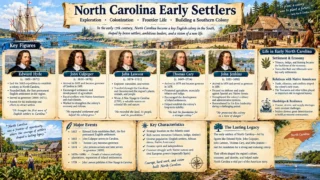
John Jenkins: Longtime Governor of Albemarle

Serving four separate terms as Governor of the Albemarle colony, John Jenkins was one of early North Carolina's most influential leaders. He strongly advocated for colonial self-governance, resisting proprietary controls and British trade restrictions under the Navigation Acts.