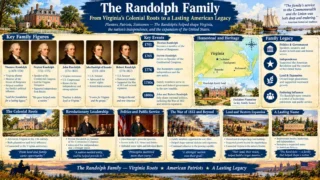
John Randolph: Royalist Attorney of Colonial Virginia

John Randolph was a leading attorney and King's Attorney for colonial Virginia who remained fiercely loyal to the British Crown. Serving as Mayor of Williamsburg and a member of the House of Burgesses, he advocated for reconciliation rather than armed rebellion. When the American Revolution escalated in 1775, his loyalist convictions led him to depart for Great Britain, where he spent his final years in exile, contrasting sharply with his patriot relatives.
The Randolph Family’s Legacy in Colonial Virginia

The Randolph family emerged as one of the most prominent First Families of Virginia, wielding tremendous political, economic, and social influence throughout the colonial era. Settling in the 17th century, they established vast tobacco plantations and held major offices in the House of Burgesses and the colonial government. Through strategic marriages and legal excellence, they formed an extensive dynasty that helped shape Virginia's leadership and produced several foundational figures during the American Revolution.

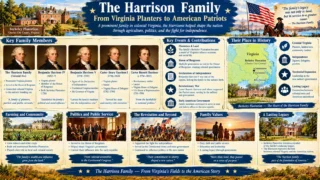
Carter Bassett Harrison: Congressional Leader

Carter Bassett Harrison was a Virginia lawyer, planter, and politician. After serving in the Revolutionary War, he represented Virginia in the U.S. House of Representatives for three terms (1793–1799) and continued to play an active role in state politics, upholding his family's deep legacy of public service.

Carter Henry Harrison I: Patriot Organizer

Carter Henry Harrison I was a prominent Virginia planter and revolutionary leader. Active in Cumberland County’s Committee of Safety, he drafted early influential instructions urging delegates to support American independence. He continued to serve his state as a long-standing member of the Virginia House of Delegates.

Benjamin Harrison V: Founding Father

Benjamin Harrison V was a key Revolutionary War leader, Virginia governor, and signer of the Declaration of Independence. Serving in the Continental Congress, he chaired the Committee of the Whole during debates on independence and actively supported the patriot cause through state and federal political leadership.

Benjamin Harrison IV: Plantation Pioneer

Benjamin Harrison IV was a major Virginia planter and politician who significantly expanded his family’s wealth and landholdings. Inheriting vast estates along the James River, he built the iconic Georgian mansion at Berkeley Plantation in 1726 and represented Charles City County in the House of Burgesses.

The Harrison Family in Colonial Virginia

The Harrison family was a prominent political and landowning dynasty in colonial Virginia. Establishing their influence through extensive plantations like Berkeley, they shaped early American history. Members actively participated in colonial legislatures, advocated for colonial rights, signed the Declaration of Independence, and produced future U.S. presidents.

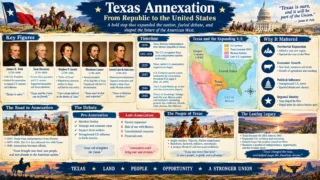
James K. Polk: Architect of Manifest Destiny

James K. Polk served as the 11th President of the United States, remembered for aggressively fulfilling the vision of Manifest Destiny. A protégé of Andrew Jackson, Polk oversaw a massive territorial expansion through the annexation of Texas, the Oregon Treaty with Britain, and the Mexican-American War. His administration successfully extended American borders to the Pacific coast, after which he fulfilled his campaign pledge to serve only a single four-year term.

Sam Houston: Hero of Texas Independence War

Sam Houston was a key soldier and political leader in the struggle for Texas independence and its subsequent statehood. As Commander-in-Chief of the Texian Army, he led the decisive victory over Mexican forces at the Battle of San Jacinto in 1836. Houston went on to serve as the first and third President of the Republic of Texas, and later represented Texas as a U.S. Senator and Governor, consistently advocating for the preservation of the Union during the sectional crisis.

Stephen F. Austin: The Father of Texas History

Stephen Fuller Austin was an American empresario who played a foundational role in the Anglo-American settlement of Texas. Inheriting a colonization grant from his father, he led the initial "Old Three Hundred" families into Mexican Texas in the 1820s. Austin managed complex relations with the Mexican government while fostering economic growth in the region, ultimately earning him the title "Father of Texas" for establishing the social and political groundwork that led to Texas independence.