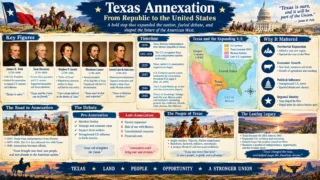
John Tyler: Precedent of Presidential Succession

John Tyler became the 10th President of the United States in 1841 following the sudden death of William Henry Harrison, establishing the historic precedent that a vice president fully assumes the office and authority of the presidency. A staunch defender of states' rights, Tyler clashed repeatedly with his own Whig Party. His administration focused heavily on territorial expansion, successfully laying the groundwork for and signing the bill to annex Texas just before leaving office.
Winfield Scott: Veteran General of the US Army

Winfield Scott was one of the most prominent military figures in American history, serving as Commanding General of the U.S. Army for two decades. Renowned for his tactical brilliance in the Mexican-American War, he led the decisive amphibious campaign from Veracruz to Mexico City. Scott ran as the Whig presidential candidate in 1852 and later devised the Union's overarching "Anaconda Plan" strategy at the onset of the American Civil War despite his advanced age.

Zachary Taylor: Mexican-American War Hero

Zachary Taylor was a career military officer and national hero whose victories at battles like Buena Vista during the Mexican-American War propelled him to the presidency in 1848. Known as "Old Rough and Ready," Taylor served in various border and Native American conflicts over four decades. As the 12th U.S. President, he adopted a surprisingly firm stance against the expansion of slavery into newly acquired territories, though his presidency was cut short by his sudden death in 1850.

Texas Annexation in the Antebellum Era

The annexation of Texas in 1845 was a pivotal event in American expansionism, sparked by the migration of American settlers into Mexican territory and the subsequent Texas Revolution. Tensions over slavery, territorial boundaries, and national sovereignty delayed its statehood for years. Its eventual admission to the Union under President John Tyler fueled sectional divisions over the expansion of slavery and directly triggered the Mexican-American War, reshaping the geopolitical map of North America.

Cotton Mather

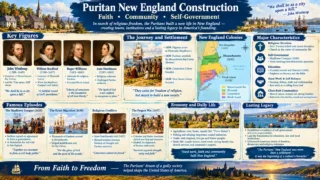
Born on February 12, 1663, in Boston, Cotton Mather was an influential Puritan minister, scholar, and author. A prominent member of the Mather family, he shaped New England's spiritual life while engaging in science and medicine, such as promoting smallpox variolation. However, his support for spectral evidence during the 1692 Salem Witch Trials drew lasting historical criticism.

Roger Williams

Born around 1603 in London, Roger Williams was a pioneer of religious liberty and the separation of church and state. Banished from Massachusetts Bay for his radical views on freedom of conscience and Native American land rights, he founded Providence, Rhode Island, in 1636. He established a haven for religious dissenters and advocated for fair relations with indigenous tribes.

Anne Hutchinson

Born around 1591 in Alford, Lincolnshire, Anne Hutchinson became a prominent religious figure in the Massachusetts Bay Colony. Her emphasis on "free grace" and critique of Puritan clergy sparked the Antinomian Controversy. Tried and banished in 1638 for challenging church authority and traditional female roles, she fled to Rhode Island, becoming an enduring symbol of religious freedom.

Puritan New England Construction

Puritan settlers built a society centered on religious devotion, communal governance, and strict moral codes in 17th-century New England. Driven by the ideal of creating a exemplary "city upon a hill," they established town meetings, Congregational churches, and early institutions like Harvard College. Their covenant-based society deeply influenced American intellectual, educational, and political traditions.

Louisiana Purchase of 1803

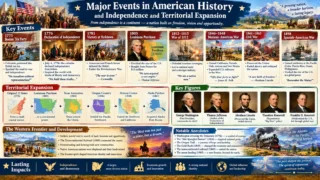
In 1803, President Thomas Jefferson purchased the vast Louisiana Territory from Napoleonic France for $15 million. This monumental land deal doubled the physical size of the United States, stretching from the Mississippi River to the Rocky Mountains. It secured vital control over the Port of New Orleans and the Mississippi River trade routes, unlocked vast resources for Western expansion, and set the stage for historic exploration by Lewis and Clark.

Constitutional Convention

Convened in Philadelphia in May 1787, delegates gathered to revise the Articles of Confederation but ultimately drafted the United States Constitution. Presided over by George Washington, the convention created a federal system with three independent branches, forming the structure of American democracy.