Constitutional Convention

Convened in Philadelphia in May 1787, delegates gathered to revise the Articles of Confederation but ultimately drafted the United States Constitution. Presided over by George Washington, the convention created a federal system with three independent branches, forming the structure of American democracy.

Declaration of Independence

Adopted by the Second Continental Congress in Philadelphia on July 4, 1776, the Declaration of Independence officially severed political ties between the Thirteen Colonies and Great Britain. Drafted primarily by Thomas Jefferson, it proclaimed fundamental human rights and established the United States as a sovereign nation.

Boston Tea Party: Act of Resistance

In December 1773, American colonists, protesting the Tea Act and British taxation without representation, boarded ships in Boston Harbor. Disguised as Mohawk Indians, they dumped 342 chests of tea into the water, sparking severe British retaliation and pushing the colonies toward revolutionary war.

Boston Massacre: Spark of Revolution

In March 1770, tensions between British soldiers and Boston colonists escalated into a deadly conflict. Redcoats fired into an angry crowd, killing five civilians. This tragic event fueled anti-British sentiment, rallied colonial unity, and became a crucial catalyst leading toward the American Revolution.

Major Frontier Milestones

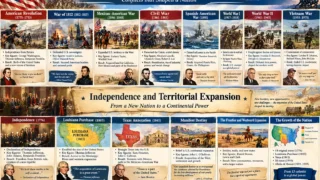
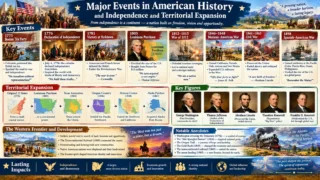
The era of American Independence and Territorial Expansion was defined by landmark milestones that reshaped the nation’s geography and geopolitical standing. Beginning with the Declaration of Independence in 1776 and the Treaty of Paris in 1783, the United States established its sovereignty and secured territory stretching to the Mississippi River. The 1803 Louisiana Purchase doubled the country’s landmass, paving the way for the Lewis and Clark Expedition and an era of unprecedented western migration. Subsequent events, such as the War of 1812, the Creek War, and the 1823 Monroe Doctrine, solidified federal sovereignty, forced massive indigenous land cessions, and barred European intervention, effectively locking in America’s rapid continental expansion.
Josiah Quincy III: Boston Statesman

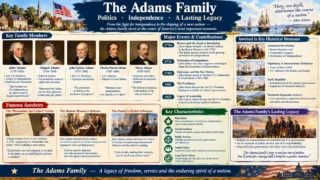
Born in Boston, Josiah Quincy III was a prominent Federalist politician, educator, and lawyer. As Mayor of Boston, he led major urban developments, including the building of Quincy Market. He later served as the 16th President of Harvard University, instituting significant educational reforms and modernization.

Abigail Adams: Advocate for Equality

Born in Weymouth, Abigail Adams was an influential First Lady and intellectual. Her extensive correspondence with her husband, John Adams, provides crucial insight into Revolutionary era politics. She famously urged political leaders to "Remember the Ladies," making her an early pioneer for women's rights and legal equality in America.

Samuel Adams: Revolutionary Leader

Born in Boston, Samuel Adams was a vital leader of the American Revolution. He founded the Sons of Liberty, organized opposition to British taxation, and was instrumental in planning the Boston Tea Party. As a delegate to the Continental Congress, he signed the Declaration of Independence and later served as Governor of Massachusetts.

The Adams Family in Colonial Times

The Adams family was one of the most influential political dynasties in colonial America, shaping early revolutionary thought and governance. Key figures like Samuel Adams organized colonial resistance, while John and Abigail Adams championed independence and political rights. Their collective efforts laid foundational principles for American democracy, liberty, and public service.

Creek War: Frontier Expansion

The Creek War (1813–1814) was a major conflict in the American Southeast, centered in Alabama during the War of 1812. U.S. forces led by Andrew Jackson defeated the "Red Sticks," a Creek faction resisting American expansion. The victory at Horseshoe Bend forced the Creeks to sign the Treaty of Fort Jackson, ceding over 20 million acres of land. This severely weakened regional Native resistance and opened vast fertile territory for American agricultural settlement.