Asian History

Asian History

Hongxi Emperor: Brief Era of Confucian Restraint

Born in Nanjing, the Hongxi Emperor had a brief eight-month reign focused on domestic stability. Educated in Confucianism, he halted costly foreign expeditions, reduced tax burdens, reorganized the administrative system, and encouraged displaced farmers to return to agriculture.
Asian History

Yongle Emperor: Expansion and Imperial Grandeur

Born in Nanjing, the Yongle Emperor seized the throne following the Jingnan Campaign. He moved the capital to Beijing, constructed the Forbidden City, restored the Grand Canal, commissioned the Yongle Encyclopedia, and sponsored Zheng He's maritime expeditions, expanding Ming influence across Asia.
Asian History

Hongwu Emperor: Founder of the Great Ming Dynasty

Born in Haozhou, the Hongwu Emperor rose from peasant poverty and monastic life to lead the Red Turban Rebellion. After overthrowing the Mongol Yuan dynasty, he founded the Ming dynasty in 1368. He revitalized agriculture, codified laws, centralized power, and instituted sweeping political purges.
Asian History

Ming and Qing Rulers: Legacy of Early Modern Empire

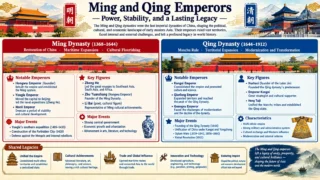
The Ming and Qing emperors shaped early modern East Asia through centralized autocratic rule and vast territorial growth. They built iconic monuments like the Forbidden City, refined bureaucratic systems, and expanded China's borders to their greatest extent, leaving a profound impact on regional governance, trade, and culture.
Asian History

Early Modern East Asia: Key Leaders and Imperial Rule

During the early modern era, dynamic leaders transformed East Asia. China's Yongle Emperor built the Forbidden City and expanded global influence through Zheng He's voyages, while Kangxi later solidified Qing rule and expanded imperial borders. In Japan, Oda Nobunaga, Toyotomi Hideyoshi, and Tokugawa Ieyasu ended feudal chaos, establishing two and a half centuries of peace under the Tokugawa shogunate.
(383 characters including spaces / 324 characters excl
Asian History

Early Modern Asian Empires: Key Figures and Turning Points

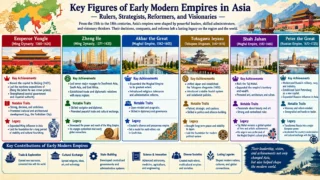
The early modern era in Asian history was defined by the rise of powerful, expansive empires. In East Asia, the Ming and Qing dynasties and Japan's Tokugawa shogunate established centralized rule and long-standing regional stability. Across South and West Asia, the Mughal, Safavid, and Ottoman Empires leveraged military innovations like gunpowder to dominate vast territories. Trade along the Silk Road and maritime routes flourished, even as European encroachment and internal struggles began to reshape the continent's balance of power.