European History

European History

Cecil Calvert: Proprietary Founding and Governance of Maryland

Cecil Calvert, the 2nd Baron Baltimore, inherited the North American colonial project from his father and became the first Proprietor of Maryland under a 1632 royal charter from Charles I. Although he never traveled to the colony, he effectively governed Maryland from England through dispatched relatives, including his brother Leonard Calvert. A devout Roman Catholic, Calvert sought to establish a sanctuary where Christians of different denominations could coexist peacefully, culminating in the passage of the landmark Maryland Toleration Act of 1649, an early pioneer of religious freedom in America.
European History

John Cabot: Voyage across the Atlantic and Exploration of North America

John Cabot was an Italian-born navigator and explorer who, after gaining Venetian citizenship, secured the backing of King Henry VII of England to seek a western sea route to Asia. In 1497, sailing from Bristol aboard the Matthew, he crossed the Atlantic Ocean and reached the eastern coastline of North America. This historic voyage marked the first European exploration of coastal mainland North America since the Norse expeditions. By claiming the territory for the English Crown, Cabot laid the historical foundation for future English colonial ambitions and settlement across the continent.
European History

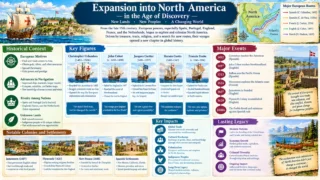
Expansion into North America in the Age of Discovery

European expansion into North America transformed global geopolitics through exploration, colonization, and commerce. European powers, notably England, France, and Spain, established territorial presence along the Atlantic coast and inland waterways. Fueled by desires for wealth, religious freedom, and strategic advantage, nations dispatched explorers to charter unknown regions and establish permanent settlements. Native American populations were profoundly affected by diplomatic treaties, land displacement, and trade networks. These early efforts established the foundation for permanent European colonies, profoundly shaping the social, economic, and political landscape of the New World.
European History

Jan Kanty Broziński

Jan Kanty Broziński was an 18th-century Polish Catholic priest and academic born in Kraków around 1737–1738. He studied at the University of Kraków, where he earned his degree in 1763 and served as a lecturer in the Faculty of Philosophy and Seven Liberal Arts. In his later years, he served as a canon at All Saints’ Collegiate Church in Kraków, dedicating twenty-six years to the priesthood until his death in 1794.
European History

Jan Łaski

Jan Łaski was an influential Polish Protestant theologian and reformer born around 1499. A close friend of Erasmus, he adopted Calvinism and led major church reform efforts across Europe, particularly in East Frisia and England. Under Edward VI, he served as superintendent of London’s Stranger Churches, shaping Protestant liturgy and governance. Returning to Poland in 1556, he served King Sigismund II Augustus and played a pivotal role in organizing the Polish Calvinist Reformation.
European History

Marcin Bylica

Marcin Bylica was a prominent 15th-century Polish astronomer, astrologer, and physician born in Olkusz. After studying at Kraków and teaching in Italy, he served as court astronomer to King Matthias Corvinus of Hungary. Collaborating with Regiomontanus, he calculated influential astronomical tables and conducted pioneering research in Buda. Before his death, he bequeathed invaluable astronomical instruments and manuscripts to the Jagiellonian University, leaving a lasting legacy on Polish science.
European History

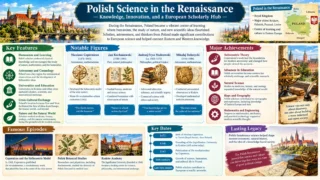
Polish Science in the Renaissance Period

The Renaissance period marked a golden age for Polish science, centered around the Jagiellonian University in Kraków. Polish scholars made monumental contributions to astronomy, mathematics, medicine, and cartography. Nicolaus Copernicus revolutionized world astronomy with his heliocentric theory, while humanists and scientists fostered active intellectual exchanges across Western Europe, establishing Poland as a major hub for scientific innovation and academic discourse.
European History

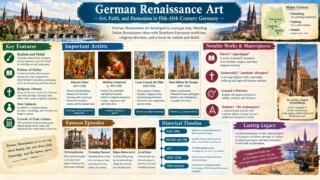
Lucas Cranach the Younger: Workshop Successor

Born Lucas Sunder in Wittenberg, Lucas Cranach the Younger was trained by his father, Lucas Cranach the Elder. Following his elder brother's death and his father's later departure, he successfully assumed leadership of the massive family workshop. He continued the tradition of producing prominent Reformation portraits, altarpieces, and mythic paintings, maintaining high artistic standards. Deeply involved in public life, Cranach the Younger served as burgomaster, councilor, and treasurer of Wittenberg, securing the family's artistic and political legacy into the late Renaissance.
European History

Hans Holbein the Younger: Court Portraitist

Originating from Augsburg, Hans Holbein the Younger achieved international acclaim through his work in Switzerland and England. A preeminent portraitist of the Northern Renaissance, he captured leading figures of his era, including Erasmus, Thomas More, and King Henry VIII. In Basel, he produced religious art and famous woodcut series like the Dance of Death, before relocating to England due to the Reformation's impact on art demand. As court painter to Henry VIII, Holbein created iconic royal portraiture, jewelry designs, and festive court decorations with stunning precision.
European History

Matthias Grünewald and the Isenheim Altarpiece

Matthias Grünewald was an extraordinary German Renaissance painter and hydraulic engineer celebrated for his intensely expressive religious masterpieces. Rejecting classical Italian idealism, he developed a unique style characterized by dramatic lighting, vibrant color contrasts, and powerful depictions of human suffering and divine mysticism. His crowning achievement, the Isenheim Altarpiece created for a hospital monastery, conveyed profound spiritual comfort to suffering patients. Serving as court painter to the Archbishop of Mainz, Grünewald remains one of the period's most emotionally compelling masters.