Abigail Adams

Abigail Adams was a key female intellectual and political advisor during the founding of the United States. As the wife of John Adams, she maintained an extensive correspondence with him, offering sharp commentary on politics, diplomacy, and societal issues. She is famously remembered for advocating women's rights and education, urging revolutionary leaders to "Remember the Ladies."
Thomas Paine

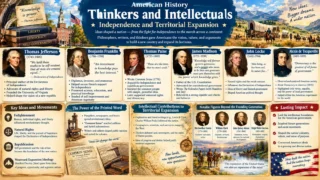
Thomas Paine was an English-born pamphleteer and revolutionary whose writings galvanized the American Revolution. His 1776 work Common Sense made a persuasive case for independence from Britain, swaying public opinion across the colonies. He also wrote The American Crisis to boost troop morale, later advocating for republicanism, human rights, and deism in Rights of Man and The Age of Reason.

Mercy Otis Warren

Mercy Otis Warren was a prominent writer, historian, and political activist of the American Revolution. She anonymously published anti-British plays and political satires to spread revolutionary ideas. A close associate of leaders like Samuel Adams and Thomas Jefferson, she supported the patriot cause and authored one of the earliest comprehensive histories of the American Revolution in 1805.

Colonial American Thinkers

Intellectuals in colonial and Revolutionary America played a key role in shaping political thought, national identity, and social reform. Through pamphlets, essays, and letters, thinkers like Thomas Paine, Mercy Otis Warren, and Abigail Adams championed liberty, republicanism, and individual rights. Later figures like Noah Webster and Ralph Waldo Emerson further defined American cultural and philosophical independence.

Joseph Warren: Physician and Revolutionary Martyr

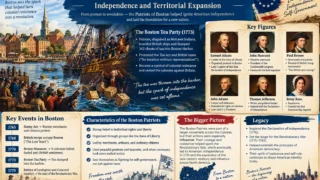
Joseph Warren was a physician and political leader who coordinated patriot activities in Boston. He helped draft the Suffolk Resolves, managed intelligence networks, and dispatched Paul Revere on his famous ride. Commissioned as a major general, he was killed at the Battle of Bunker Hill in 1775, becoming an enduring symbol of revolutionary sacrifice.

John Hancock: Merchant and President of Congress

John Hancock was a wealthy merchant, politician, and prominent patriot leader who served as President of the Continental Congress. Renowned for his bold, iconic signature on the Declaration of Independence, he helped fund and unify revolutionary efforts. Following the war, he served as the first Governor of Massachusetts, shaping the new state's politics.

Paul Revere: Messenger and Patriotic Silversmith

Paul Revere was a silversmith, engraver, and messenger for the colonial movement. Famous for his 1775 "Midnight Ride" warning militias of approaching British troops before Lexington and Concord, he became an iconic figure of the Revolution. As a Son of Liberty, he organized intelligence networks and later built a successful metalworking business.

Mercy Otis Warren: Historian and Political Satirist

Mercy Otis Warren was a writer, playwright, and historian who supported independence through political satires, poems, and plays. Sister to James Otis Jr., she corresponded with key leaders like John Adams and Thomas Jefferson. In 1805, she published a comprehensive history of the Revolution, establishing her legacy as a pioneering female intellectual.

James Otis Jr.: Advocate for Colonial Rights

James Otis Jr. was a lawyer and orator who challenged British authority by opposing Writs of Assistance. His passionate courtroom defense popularized the principle "no taxation without representation," establishing the intellectual foundation for colonial resistance. Although mental health struggles shortened his career, he remains a key pioneer of revolutionary thought.

Samuel Adams: Leader of Revolutionary Resistance

Samuel Adams was a political organizer and Founding Father who mobilized resistance against British tax policies. As a leader of the Sons of Liberty, he organized protests and promoted colonial unity through the Committees of Correspondence. He played a pivotal role in the Boston Tea Party, signed the Declaration of Independence, and later served as Governor of Massachusetts.