Nathanael Greene: Savior of the South

Nathanael Greene was one of George Washington's most trusted generals in the Continental Army. Raised in a Quaker family, he emerged as a brilliant strategist, particularly in the Southern Theater. Using clever guerrilla tactics and strategic retreats, he severely weakened British forces in the South, paving the way for the ultimate American victory at Yorktown.
John Hancock: Bold Signer and Patriot

John Hancock was a prominent merchant and politician who served as President of the Second Continental Congress. He is world-famous for his unusually large, bold signature on the Declaration of Independence, making his name synonymous with signatures in American culture. He funded patriot causes, helped unify colonial resistance, and served as the first Governor of Massachusetts.

Patrick Henry: Voice of American Liberty

Patrick Henry was a fiery orator, attorney, and Founding Father whose passionate speeches galvanized anti-British sentiment across the colonies. Famous for declaring "Give me liberty, or give me death!" in 1775, he strongly opposed British taxation without representation. He served as the first Governor of Virginia and later advocated for individual rights as a prominent Anti-Federalist.

Paul Revere: Midnight Rider of Liberty

Paul Revere was a Boston silversmith, engraver, and patriot best known for his legendary "Midnight Ride" in April 1775. He rode through Massachusetts countryside to warn colonial militias of advancing British troops before the Battles of Lexington and Concord. As an active member of the Sons of Liberty, he became an enduring symbol of American patriotism.

George Washington: Father of His Country

George Washington served as Commander-in-Chief of the Continental Army during the American Revolutionary War, leading the colonies to victory over Great Britain. He presided over the Constitutional Convention and became the first President of the United States. Renowned for his leadership, integrity, and voluntary relinquishment of power, he established key democratic traditions for the nation.

Horatio Gates: Hero of Saratoga

Horatio Lloyd Gates was a British-born general who served in the Continental Army during the American Revolutionary War. He gained national acclaim for commanding American forces to victory at the Battle of Saratoga in 1777, a decisive turning point that brought French assistance. Despite later controversy following his defeat at Camden, his contributions remained significant.

Benjamin Franklin: Polymath Founder

Benjamin Franklin was a renowned polymath, inventor, and statesman who played a vital role in securing American independence. Famous for his electrical experiments and inventing the lightning rod, he also helped draft the Declaration of Independence and the U.S. Constitution. His diplomatic efforts in France secured crucial military and financial support, making him an indispensable Founding Father.

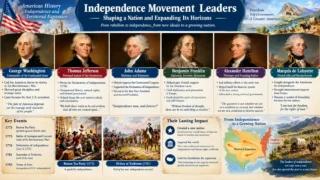
Leaders of American Independence

American independence movement leaders united the Thirteen Colonies against British rule through political activism, diplomacy, and armed resistance. Driven by opposition to unfair taxation and lack of representation, visionaries like Washington, Jefferson, and Franklin organized protests, drafted foundational documents, and led the Continental Army. Their collective bravery and political philosophy forged a new democratic nation built on freedom.

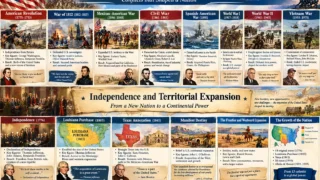
War of 1812

The War of 1812 (1812–1815) was fought between the U.S. and Great Britain. Conflicts in the Southern U.S., particularly around Alabama and Tennessee, included the Creek War, securing American sovereignty and opening vast territories for settlement.

American Revolutionary War

The American Revolutionary War (1775–1783) was fought between Thirteen American Colonies and Great Britain. Actions across regions including the Southern Colonies and Western Appalachia secured American independence, leading to the 1783 Treaty of Paris and the birth of the United States.