The Adams Family in Colonial Times

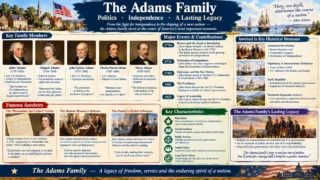
The Adams family was one of the most influential political dynasties in colonial America, shaping early revolutionary thought and governance. Key figures like Samuel Adams organized colonial resistance, while John and Abigail Adams championed independence and political rights. Their collective efforts laid foundational principles for American democracy, liberty, and public service.
Creek War: Frontier Expansion

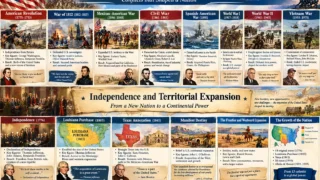
The Creek War (1813–1814) was a major conflict in the American Southeast, centered in Alabama during the War of 1812. U.S. forces led by Andrew Jackson defeated the "Red Sticks," a Creek faction resisting American expansion. The victory at Horseshoe Bend forced the Creeks to sign the Treaty of Fort Jackson, ceding over 20 million acres of land. This severely weakened regional Native resistance and opened vast fertile territory for American agricultural settlement.

Meriwether Lewis: Leader of Western Expedition

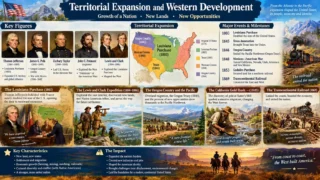
Meriwether Lewis was an army officer and personal secretary to President Thomas Jefferson who commanded the famous Corps of Discovery expedition. Tasked with exploring the newly acquired Louisiana Territory, Lewis led his team across rugged mountains and rivers to the Pacific Northwest. His detailed scientific logs, geographical records, and botanical observations proved invaluable for subsequent American expansion and scientific knowledge.

William Clark: Explorer of the American West

William Clark was a skilled soldier, cartographer, and co-leader of the historic Lewis and Clark Expedition. Between 1804 and 1806, he helped map the vast uncharted territories acquired in the Louisiana Purchase, successfully navigating to the Pacific Ocean. Clark established vital diplomatic relations with Native American tribes and later served as Governor of the Missouri Territory and Superintendent of Indian Affairs.

James Monroe: Guardian of American Diplomacy

James Monroe, the fifth U.S. President, guided the nation through a period of stability known as the Era of Good Feelings. A Revolutionary War veteran and skilled diplomat, he played a crucial role in negotiating the Louisiana Purchase. Monroe is best remembered for proclaiming the 1823 Monroe Doctrine, which firmly opposed European intervention in the Western Hemisphere and established a cornerstone of American foreign policy.

Thomas Jefferson: Author of American Liberty

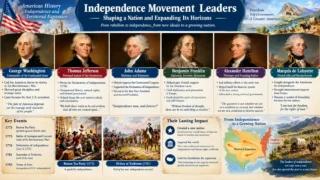
Thomas Jefferson was a Founding Father and the principal author of the Declaration of Independence. As the third U.S. President, he dramatically expanded the nation by negotiating the 1803 Louisiana Purchase, doubling the country's size. A champion of agrarian democracy, states' rights, and intellectual enlightenment, Jefferson also founded the University of Virginia, leaving a profound mark on early American politics and culture.

Daniel Boone: Legendary Western Trailblazer

Daniel Boone was a legendary American frontiersman whose exploration of Kentucky opened the West for settlement. He blazed the famous Wilderness Road through the Cumberland Gap, enabling thousands of pioneers to migrate beyond the Appalachian Mountains. During the Revolutionary War, Boone defended frontier settlements against British-allied native forces, cementing his enduring legacy as an iconic symbol of American frontier spirit and courage.

Colonial Territorial Expansion

During the colonial era, settlers gradually pushed westward from the Atlantic coast, transforming dense wilderness into agricultural lands and communities. Driven by land scarcity, economic opportunity, and geopolitical rivalry, frontiersmen crossed the Appalachian Mountains. This relentless push westward laid the essential groundwork for American territorial growth, reshaping early geography while triggering profound cultural, economic, and military conflicts with native indigenous tribes.

Alexander Hamilton: Financial Architect

Alexander Hamilton was an influential Founding Father, aide-de-camp to Washington, and the first U.S. Secretary of the Treasury. He co-authored The Federalist Papers to promote the ratification of the Constitution. As Treasury Secretary, he established the national bank, restructured public debt, and laid the financial and industrial foundations of the modern American economy.

John Paul Jones: Father of the U.S. Navy

John Paul Jones was a Scottish-born naval officer who became a celebrated hero of the Continental Navy during the Revolutionary War. Famous for raiding British coastal shipping and declaring "I have not yet begun to fight!" during the Battle of Flamborough Head, he captured the British warship Serapis. He is widely honored as the Father of the American Navy.