The 1979 Iranian Revolution
Iranian Revolution
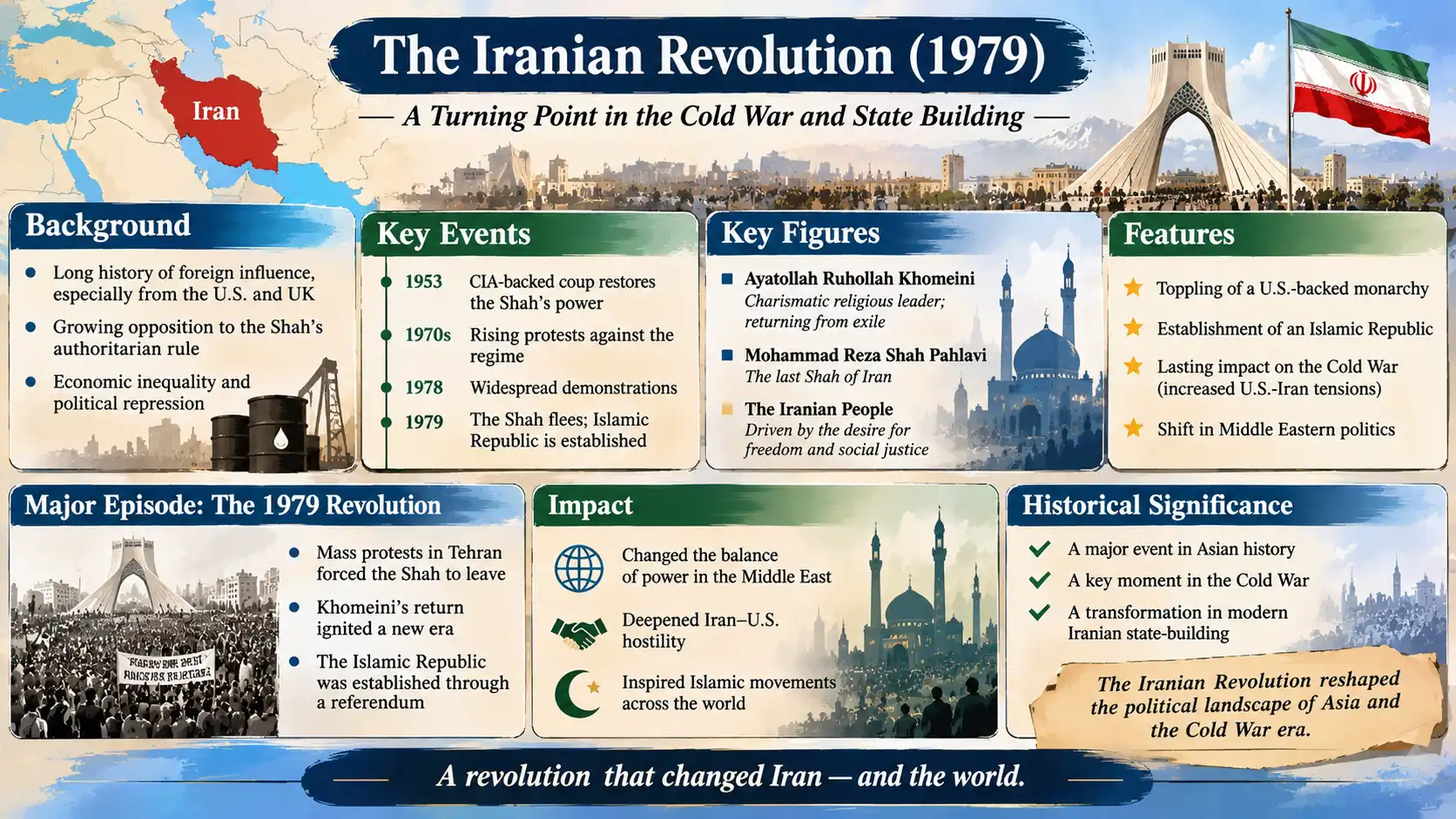
The 1979 Iranian Revolution fundamentally reshaped Middle Eastern geopolitics during the Cold War by overthrowing the pro-Western Pahlavi monarchy. Triggered by widespread public discontent over authoritarian rule, rapid modernization, and foreign influence, a broad coalition of clerics, secularists, and leftists mobilized massive demonstrations and strikes. Led by Ayatollah Ruhollah Khomeini from exile, the movement forced Shah Mohammad Reza Pahlavi to flee Iran. The revolution culminated in a national referendum that established the Islamic Republic, transforming Iran from a key U.S. ally into an anti-imperialist theocracy that challenged both Western superpower influence and Soviet ideological expansion across the region.
People
Birth
Death
Origin
Age (Death)
| 1902 | |
|---|---|
| 1903 | |
| 1906 | |
| 1906 | |
| 1907 | |
| 1928 | |
| 1933 | |
| 1933 | |
| 1934 | |
| 1939 |
Timeline
| Category | |
|---|---|
| Element |
| Year | Iranian Revolution |
|---|---|
| 1902 |
Birth of Ruhollah Khomeini (Period: September 24, 1902 (Disputed theories exist regarding birth year and date), Location: Khomein, Persia (present-day Khomein, Markazi Province, Iran))
|
| 1903 |
Birth of Mustafa Barzani (Period: March 14, 1903, Location: Barzan, Ottoman Empire (present-day Barzan, Kurdistan Region, Iraq))
|
| 1906 |
Early religious education and social activities (Hassan al-Banna, Period: 1906–early 1920s, Location: Mahmoudiyah, Egypt)
Detention of the Barzani clan
Birth of Sayyid Qutb (Period: October 9, 1906, Location: Musha village, Egypt (present-day near Asyut City, Asyut Governorate))
Birth of Hassan al-Banna (Period: October 14, 1906, Location: Mahmoudiyah, Egypt (a city in present-day Beheira Governorate))
|
| 1907 |
Birth of Mehdi Bazargan (Period: September 1, 1907, Location: Tehran, Iran (present-day Tehran City, Iran))
|
| 1910 |
Early education and recitation of the Quran (Sayyid Qutb)
|
| 1920 |
Studies in France and engineering education (Mehdi Bazargan)
Entry into teacher training course and employment as a teacher
|
| 1928 |
Founding of the Muslim Brotherhood
Birth of Mohammad Beheshti (Period: October 24, 1928, Location: Isfahan, Iran (present-day Isfahan City))
|
| 1929 |
Studies at Dar al-Ulum
|
| 1930 |
Marriage (Ruhollah Khomeini, Khadijeh Saqafi)
Teaching at Tehran University and management of the Faculty of Engineering (Mehdi Bazargan)
Literary and critical activities
Expansion of the Muslim Brotherhood's political and social movement
Marriage (Hassan al-Banna, details unknown (generally in biographies as founder of the Muslim Brotherhood, marriage)
Participation in the Kurdish national movement
|
| 1933 |
Birth of Abolhassan Banisadr (Period: March 22, 1933, Location: Baghche village near Hamadan, Iran (present-day Hamadan Province))
Birth of Ali Shariati (Period: November 23, 1933, Location: Kahak village, Khorasan region, Iran (an area considered near Sabzevar, not present-day Semnan Province))
|
| 1934 |
Birth of Akbar Hashemi Rafsanjani (Period: August 25, 1934, Location: Rafsanjan County, Iran (present-day around Rafsanjan City, Kerman Province))
|
| 1939 |
World War II
Marriage (Mehdi Bazargan, Malak Tabatabaei)
Birth of Ali Khamenei (Period: April 19, 1939 (Some sources list July, and disputed theories exist regarding the date), Location: Mashhad, Iran (present-day Mashhad, Razavi Khorasan Province, Iran))
|
| 1940 |
Beginning of religious education and political activities (Akbar Hashemi Rafsanjani)
Religious education and academic research (Mohammad Beheshti)
Religious and philosophical education and influence of his father (Ali Shariati)
|
| 1943 |
1943 Barzani revolt
|
| 1945 |
Fighting over the Republic of Mahabad
Assassination of Prime Minister Ahmad Mahir by the Muslim Brotherhood
|
| 1946 |
Assumption of leadership of the Kurdistan Democratic Party (Mustafa Barzani)
|
| 1947 |
First Arab-Israeli War
Exile to the Soviet Union (Mustafa Barzani)
|
| 1948 |
Studies in the United States
Dissolution of the Muslim Brotherhood
Assassination of Prime Minister Mahmud an-Nukrashi by Muslim Brotherhood members
|
| 1949 |
Death of Hassan al-Banna
Assassination of Hassan al-Banna
|
| 1950 |
Rise as a religious leader
Religious education and meeting Khomeini (Ali Khamenei)
Participation in the National Front and anti-Shah movement
Entry into teacher training college and educational activities (Ali Shariati)
Joining the Muslim Brotherhood
|
| 1951 |
Cooperation in oil nationalization
|
| 1952 |
1952 anti-government demonstrations and arrest
1952 Egyptian revolution
|
| 1953 |
Participation in the National Resistance Movement
1953 Iranian coup d'état
|
| 1954 |
Algerian War of Independence
Writing activities while imprisoned
1954 assassination attempt on Nasser and crackdown on the Muslim Brotherhood
|
| 1957 |
1957 arrest of individuals connected to the National Resistance Movement
|
| 1958 |
Marriage (Akbar Hashemi Rafsanjani, Effat Marashi)
Marriage (Ali Shariati, Bibi Fatemeh Shariati Razavi)
Return to Iraq (Mustafa Barzani)
|
| 1959 |
Studies in France and research at Sorbonne University
Solidarity with the Algerian independence movement
|
| 1960 |
Formation of the theory of Guardianship of the Islamic Jurist
Participation in anti-Shah movement and arrest
Studies in France, exile, and formation of political thought (Abolhassan Banisadr)
Anti-Shah activities and arrest
Arrests and detentions of anti-government activists by the Pahlavi dynasty
Participation in the anti-Shah movement
|
| 1961 |
Marriage (Abolhassan Banisadr, Ozra Hosseini)
Participation in overseas activities of the Freedom Movement of Iran
Iraqi–Kurdish conflict
Demonstrations related to Algerian independence in Paris and arrest
Establishment of the Freedom Movement of Iran
|
| 1963 |
Opposition to the White Revolution
1963 anti-Shah protest movement and injury
1963 anti-government movement, arrest, and imprisonment
Anti-government demonstrations and crackdowns in June 1963
|
| 1964 |
Marriage (Ali Khamenei, Mansoureh Khojasteh Bagherzadeh)
Arrest and detention upon return to Iran (Ali Shariati)
Release and publication of "Milestones"
Exile (Ruhollah Khomeini)
|
| 1965 |
Activities at the Islamic Centre Hamburg
Teaching activities at Mashhad University (Ali Shariati)
Suspicions of a plot to overthrow the government by the Muslim Brotherhood
Re-arrest, trial, and execution
|
| 1966 |
Death of Sayyid Qutb
|
| 1967 |
Lecturing activities at Hosseiniye Ershad
|
| 1970 |
1970 Autonomy Accord
|
| 1971 |
Assassination attempt on Barzani
|
| 1972 |
Closure of Hosseiniye Ershad and re-arrest
|
| 1974 |
Iraqi–Kurdish conflict (1974–1975 revolt)
|
| 1975 |
Surveillance after release and emigration abroad (Ali Shariati)
Algiers Agreement and collapse of the revolt
|
| 1976 |
Medical treatment in the United States and death
|
| 1977 |
Death of Ali Shariati
Assassination suspicions regarding the death of Shariati
Death and intellectual influence
|
| 1978 |
Iranian Revolution
Participation in the Iranian Revolution
1979 Iranian Revolution
Iranian Revolution and participation in the Revolutionary Council
Relocation to near Paris and leadership of the revolutionary movement (Ruhollah Khomeini)
|
| 1979 |
Activities in the Revolutionary Council and Parliament
Iranian Revolution and return to Iran (Ruhollah Khomeini)
Iranian Revolution and return to Iran (Abolhassan Banisadr)
Establishment of the Islamic Republican Party
Appointment as Prime Minister of the Interim Government
Death of Mustafa Barzani
Establishment of the Islamic Republic of Iran
Participation in the Assembly of Experts for Constitution
Appointment as Minister of Finance (Abolhassan Banisadr)
Iran hostage crisis
Resignation of the Interim Government (Mehdi Bazargan)
Approval of the new constitution
|
| 1980 |
Activities defending democracy and human rights
Assumption of the Speakership of Parliament after the Iranian Revolution (Akbar Hashemi Rafsanjani)
Assumption of the office of Chief Justice (Mohammad Beheshti)
Inauguration as President of Iran (Abolhassan Banisadr)
Election to Parliament
Iran–Iraq War
Military command during the early stage of the Iran–Iraq War (Abolhassan Banisadr)
|
| 1981 |
Formation of the National Council of Resistance
1981 assassination attempt on Rafsanjani
Dismissal as President and exile to France (Abolhassan Banisadr)
Impeachment and dismissal of the President (Abolhassan Banisadr)
Assassination attempt on Khamenei
Death of Mohammad Beheshti
Hafte Tir bombing
Death in the Hafte Tir bombing
Exile of Banisadr (Abolhassan Banisadr)
Inauguration as President of Iran (Ali Khamenei)
|
| 1988 |
Coordination toward ending the Iran–Iraq War
Acceptance of the cease-fire in the Iran–Iraq War
|
| 1989 |
Expansion of power of the Islamic Revolutionary Guard Corps
Post-war reconstruction and economic rebuilding policies
Fatwa against Nobel laureate Salman Rushdie
Death of Ruhollah Khomeini
Death of Khomeini
Inauguration as Supreme Leader of the Islamic Republic of Iran (Ali Khamenei)
Inauguration as President of Iran (Akbar Hashemi Rafsanjani)
|
| 1990 |
First Gulf War
|
| 1992 |
Mykonos restaurant assassinations
|
| 1993 |
Re-election as President
|
| 1995 |
Death of Mehdi Bazargan
Death of Bazargan
|
| 1999 |
1999 Tehran University student protests
|
| 2000 |
Diplomatic negotiations regarding nuclear development
|
| 2007 |
Assumption of the Chairmanship of the Assembly of Experts (Akbar Hashemi Rafsanjani)
|
| 2009 |
Protests following the 2009 Iranian presidential election (Green Movement)
|
| 2011 |
Syrian civil war
|
| 2017 |
Death of Akbar Hashemi Rafsanjani
Death
|
| 2021 |
Death of Abolhassan Banisadr
Death of Banisadr
|
| 2022 |
Death of Mahsa Amini and "Woman, Life, Freedom" protests
|
| 2024 |
Direct conflict between Iran and Israel
|
| 2025 |
Twelve-Day War (2025 Iran–Israel War)
|
| 2026 |
2026 Iran War
Death of Ali Khamenei
Death of Khamenei
Death of Khamenei and selection of a successor
|
| Unknown |
Marriage (Mohammad Beheshti, Ezzat al-Sharia Modarres Motlaq, Period: Details unknown, Location: Details unknown)
Marriage (Mustafa Barzani, details unknown, Period: Details unknown, Location: Details unknown)
Marriage (Sayyid Qutb, details unknown, Period: Said to have remained single throughout life, Location: No applicable record of marriage can be confirmed)
|
Map
| Category | |
|---|---|
| Element |
Asia
World
Related Links
| Group | List |
|---|---|
| West Asia | Establishment of Israel Iranian Revolution |
Comments